Results
This section reports repository facts produced by the meta-project’s live introspection pass. Test counts, module inventories, pipeline-stage counts, and figure data are injected from generated artifacts. Runtime and achieved-coverage claims are intentionally omitted when no versioned benchmark or coverage artifact backs them.
Multi-Project Pipeline Execution
The ./run.sh interactive orchestrator can execute the
public roster through the shared DAG. The table below is a structural
snapshot, not a timing benchmark: counts come from repository
introspection, and the coverage column states each exemplar’s declared
policy floor rather than an unversioned observed percentage.
| Project | Effective core stages¹ | Discovered tests | Declared project floor |
|---|---|---|---|
template_code_project |
8 | 263 | 90% |
template_prose_project |
8 | 165 | 90% |
template_autoresearch_project |
8 | 318 | 90% |
¹“Core-only” excludes LLM-tagged and other opt-in stages according to the YAML stage tags. A fresh run must be used to establish completion status or wall-clock performance for a particular machine and dependency set.
Infrastructure Test Suite
| Metric | Value |
|---|---|
| Test files | 947+ |
| Total tests | ~12,564 |
| Infrastructure coverage gate | ≥60% configured floor |
| Prohibited mock-framework imports | Checked by the static no-mocks gate |
Exercises Pandoc/XeLaTeX paths, steganography hashing, telemetry,
YAML-driven pipeline DAG resolution, HTTPS-bound optional suites
(pytest-httpserver), and local Ollama-gated subsets.
Infrastructure Module Inventory
The introspection module
(template_template.core.introspection) emits the
authoritative table below—every row reflects
discover_infrastructure_modules(REPO_ROOT).
| Module | Python Files | Has AGENTS.md | Has README.md | Key Exports |
|---|---|---|---|---|
autoresearch |
11 | ✓ | ✓ | build_autoresearch_plan, readiness validation CLI |
benchmark |
4 | ✓ | ✓ | Template harness scoring + comparative gates |
config |
0 | ✓ | ✓ | Repository defaults + hardened templates |
core |
201 | ✓ | ✓ | get_logger, load_config,
TemplateError |
docker |
0 | ✓ | ✓ | Containerisation scaffolding |
doctor |
14 | ✓ | ✓ | Checkout diagnose/fix/undo repairs |
documentation |
23 | ✓ | ✓ | FigureManager, build_api_index,
generate_markdown_table |
fonds |
6 | ✓ | ✓ | — |
formal_contracts |
5 | ✓ | ✓ | — |
llm |
57 | ✓ | ✓ | Ollama helpers, sanitization, review + translation pipelines |
logrotate.d |
0 | ✓ | ✓ | Rotation snippets (documentation-first) |
metadata |
3 | ✓ | ✓ | normalized_repository_url,
generate_metadata_package |
methods |
10 | ✓ | ✓ | build_methods_orchestration_plan, methods-stage
contracts + validation |
orchestration |
14 | ✓ | ✓ | PipelineRunner, entry point for
./run.sh |
project |
116 | ✓ | ✓ | discover_projects, workspace management |
prose |
9 | ✓ | ✓ | Markdown readability + prose tooling |
provenance |
9 | ✓ | ✓ | — |
publishing |
85 | ✓ | ✓ | Zenodo, executable bundle, archival targets |
reference |
16 | ✓ | ✓ | BibTeX models, parsers, converters |
rendering |
121 | ✓ | ✓ | PDF/HTML/slide rendering, Pandoc filters |
reporting |
412 | ✓ | ✓ | Coverage parsers, dashboards, executive artefacts |
research |
3 | ✓ | ✓ | — |
rules |
6 | ✓ | ✓ | — |
scientific |
4 | ✓ | ✓ | check_numerical_stability,
benchmark_function |
search |
77 | ✓ | ✓ | infrastructure.search.literature clients + cache |
sia |
10 | ✓ | ✓ | Self-Improving-AI loop: task validation, harness, metric capture |
skills |
8 | ✓ | ✓ | discover_skills, SKILL manifest regeneration |
steganography |
13 | ✓ | ✓ | Watermark overlays + hash manifests |
tools |
6 | ✓ | ✓ | — |
transmission |
6 | ✓ | ✓ | — |
validation |
86 | ✓ | ✓ | PDF + Markdown + integrity CLIs |
All 31 enumerated subdirectories carry Tier‑1/README.md
and Tier‑2/AGENTS.md coverage wherever the Documentation
Duality standard applies; subsets ship Tier‑3 SKILL.md
descriptors for MCP routing (infrastructure/skills manifest
generation).
Agentic Skill Documentation Coverage
| Layer | Role |
|---|---|
| Shared agent guidance | Root AGENTS.md, .agents/ skills, roles,
and workflows |
| Structural | AGENTS.md directories |
| Skills | Optional SKILL.md manifests + generated
.agents/skill_manifest.json |
| PAI capsule | Repository level PAI.md narratives |
378+ Markdown shards under docs/ capture
operational knowledge without duplicating auto-generated
inventories.
DAG Reference (Declarative Executor)
The table summarizes the 10 default full-run stages (core plus live LLM nodes) from 17 YAML declarations; core mode selects 8. Separately tagged opt-in extensions are omitted here. Entries follow dependency order rather than numeric script filenames.
| Name | Typical script / method | Responsibility | Failure semantics |
|---|---|---|---|
| Clean Output Directories | _run_clean_outputs |
Deletes stale output/ trees |
Blocking |
| Environment Setup | scripts/pipeline/stage_00_setup.py |
Validates tooling, PYTHONPATH scaffolding | Blocking |
| Infrastructure Tests | scripts/pipeline/stage_01_test.py
--infra-only --infra-scope
pipeline-smoke |
Focused infrastructure smoke contracts | Required tests must pass |
| Project Tests | scripts/pipeline/stage_01_test.py
--project-only |
Project-local tests + coverage gates | Required tests and coverage must pass |
| Project Analysis | scripts/pipeline/stage_02_analysis.py |
Executes projects/<name>/scripts/*.py |
Blocking |
| PDF Rendering | scripts/pipeline/stage_03_render.py |
Pandoc → XeLaTeX manuscripts | Blocking |
| Output Validation | scripts/pipeline/stage_04_validate.py |
Structural PDF/markdown probes | Blocking / warnings |
| LLM Manuscript Review | scripts/pipeline/stage_06_llm_review.py
--reviews-only |
Local Ollama reviews | Fresh policy-bound skip; required live acceptance remains blocking |
| LLM Translations | scripts/pipeline/stage_06_llm_review.py
--translations-only |
Optional translations | Fresh policy-bound skip |
| Copy Outputs | scripts/pipeline/stage_05_copy.py |
Mirrors deliverables → output/<project>/ |
Blocking |
scripts/pipeline/stage_07_executive_report.py provides
separate multi-project executive reporting, not an
additional single-project DAG node (execute_pipeline.py).
The multi-project executor writes its aggregate summary after project
execution.
Steganographic Performance Boundary
The steganography path exposes metadata injection, SHA-256 hashing, overlay generation, and optional QR-code insertion as separately testable operations. This revision makes no latency claim because the project does not currently generate a versioned benchmark artifact recording hardware, input PDF, warm-up policy, repetitions, and dispersion. A future performance table should be compiled from such an artifact rather than copied from an ad-hoc workstation run.
Self-Referential Analysis
Rendered via projects/templates/template_template
(generate_manuscript_metrics.py → injected tokens such as
31). Architecture figures stem from template_template.figures.architecture_viz—font
sizes constrained by §QA.
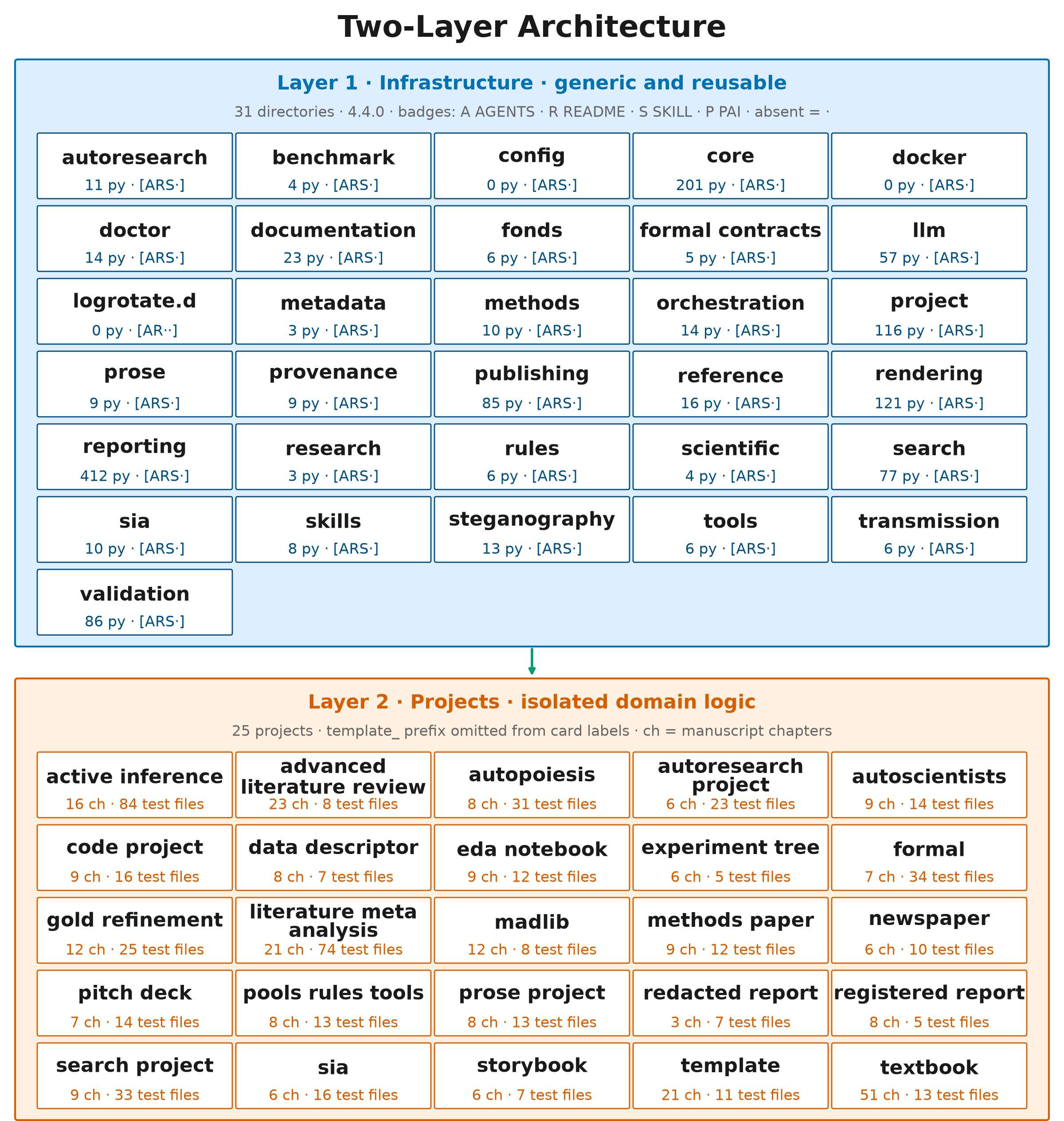
31 enumerated infrastructure directories,
each annotated with its Python file count and a four-slot documentation
badge—A AGENTS.md, R README.md, S
SKILL.md, P PAI.md, with · marking an absent
file—so a fully documented module reads [ARSP]. A YAML DAG
arrow connects it to the project layer (bottom) of public exemplars
labelled with chapter and test-file counts. The takeaway:
documentation-duality coverage is near-uniform across the
infrastructure, and every box was placed from the same live data the
prose cites.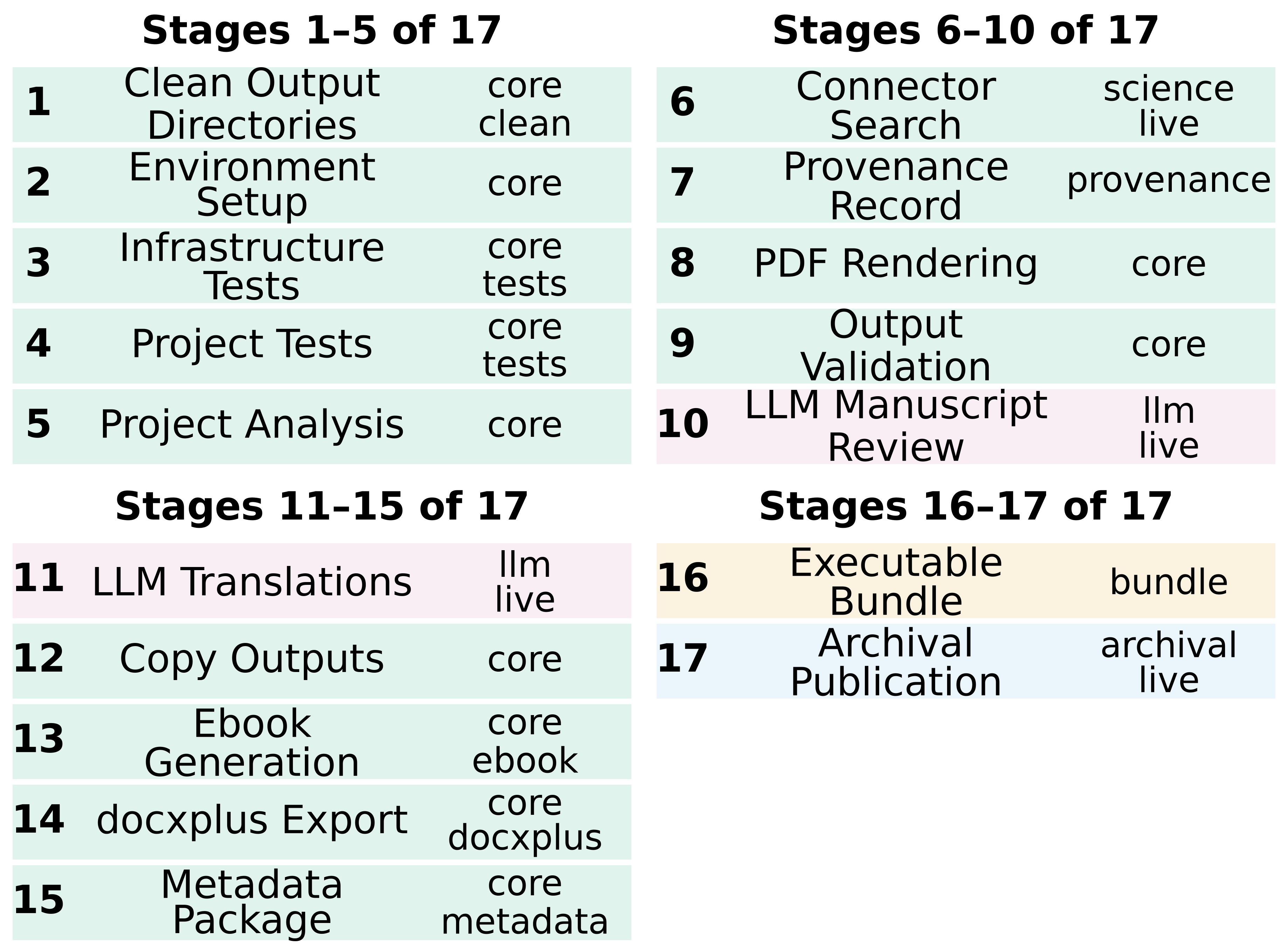
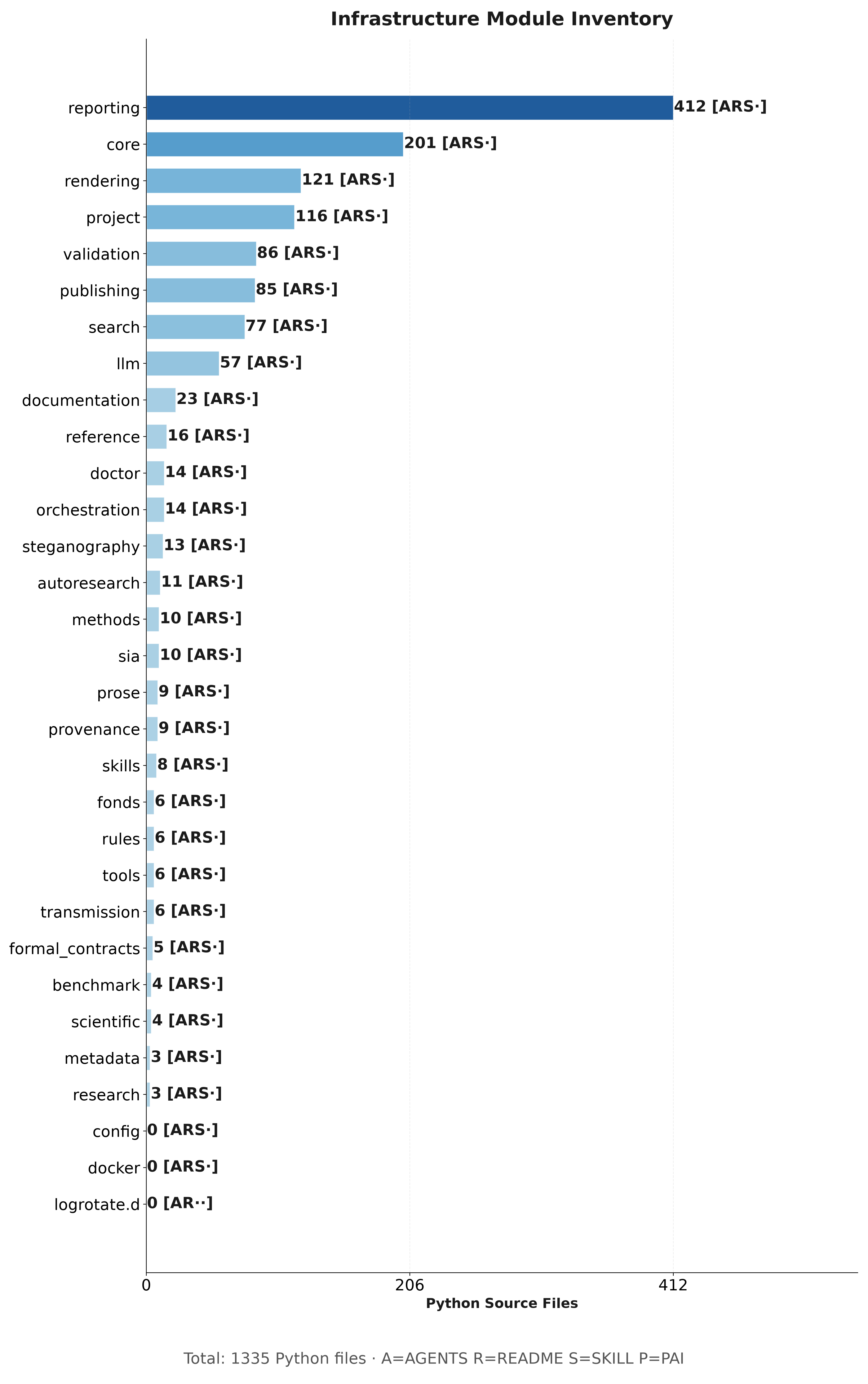
The long tail of small, single-purpose packages beside a handful of
larger ones (core, validation,
publishing) is the visual signature of the Unix-philosophy
modularity the architecture section argues for—capability concentrated
where it compounds, not spread evenly by fiat.
Comparative Feature Analysis
The comparative feature matrix below summarizes the Appendix F capability matrix.
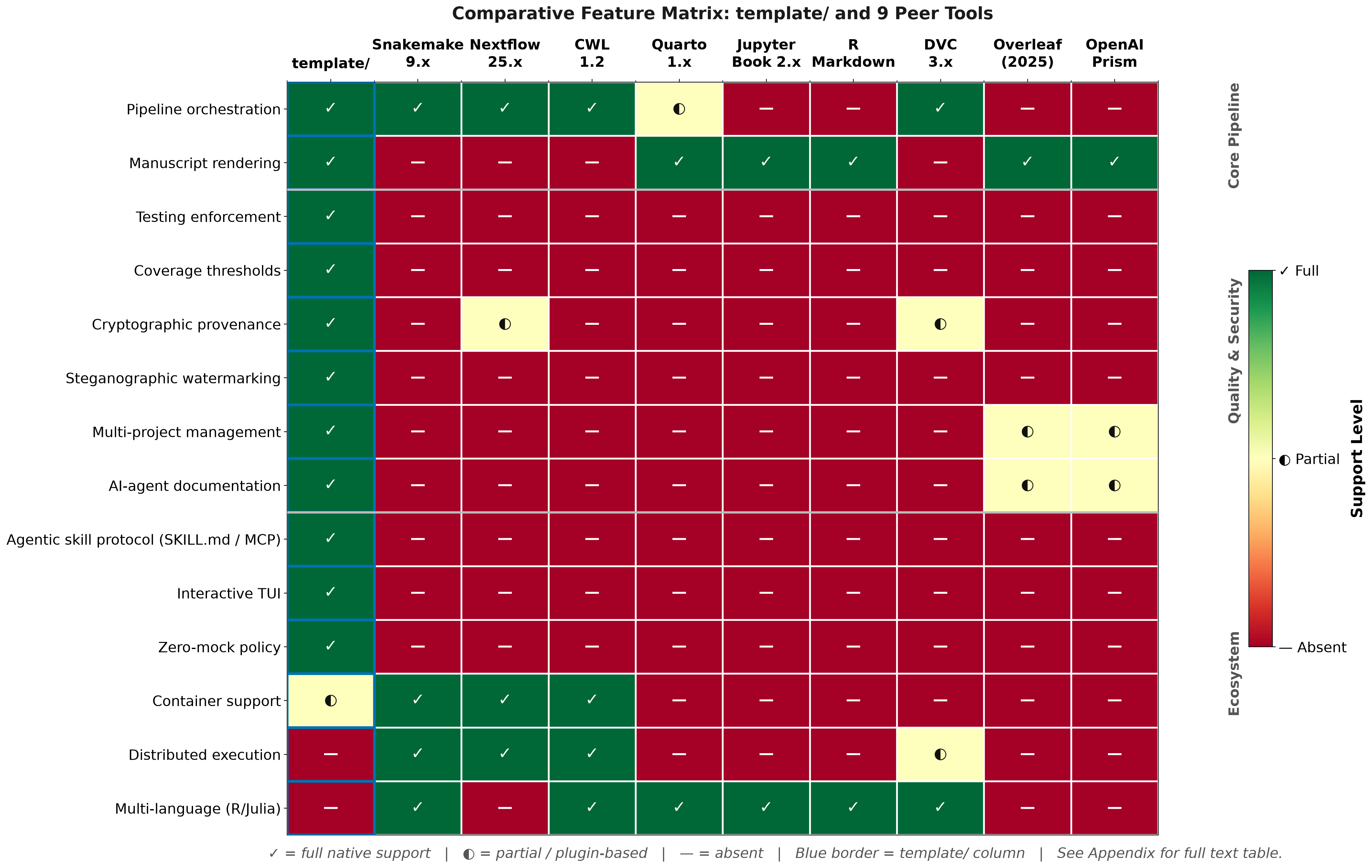
¹ Nextflow lineage records exist at workflow scope, not per rendered PDF citation graph.
² DVC: content-addressed artifacts without native prose rendering.
³ DVC: remote object stores (S3, GCS, Azure) without turnkey CI manuscript gates.
Test Quality Metrics
Zero mocks: repository policy bans
unittest.mock/ patching frameworks in tests.Filesystem + subprocess realism: ephemeral directories + actual CLI binaries.
HTTP realism: infra suites favour
pytest-httpserver; literature tests hit recorded fixtures.template_code_projectfocuses on numerical reproducibility assertions.template_autoresearch_projectexercises the AutoResearch readiness planner (infrastructure/autoresearch/).template_search_projectexercises literature-search workflows.